Time Forecasting of PM2.5 via Neural Network
Overview
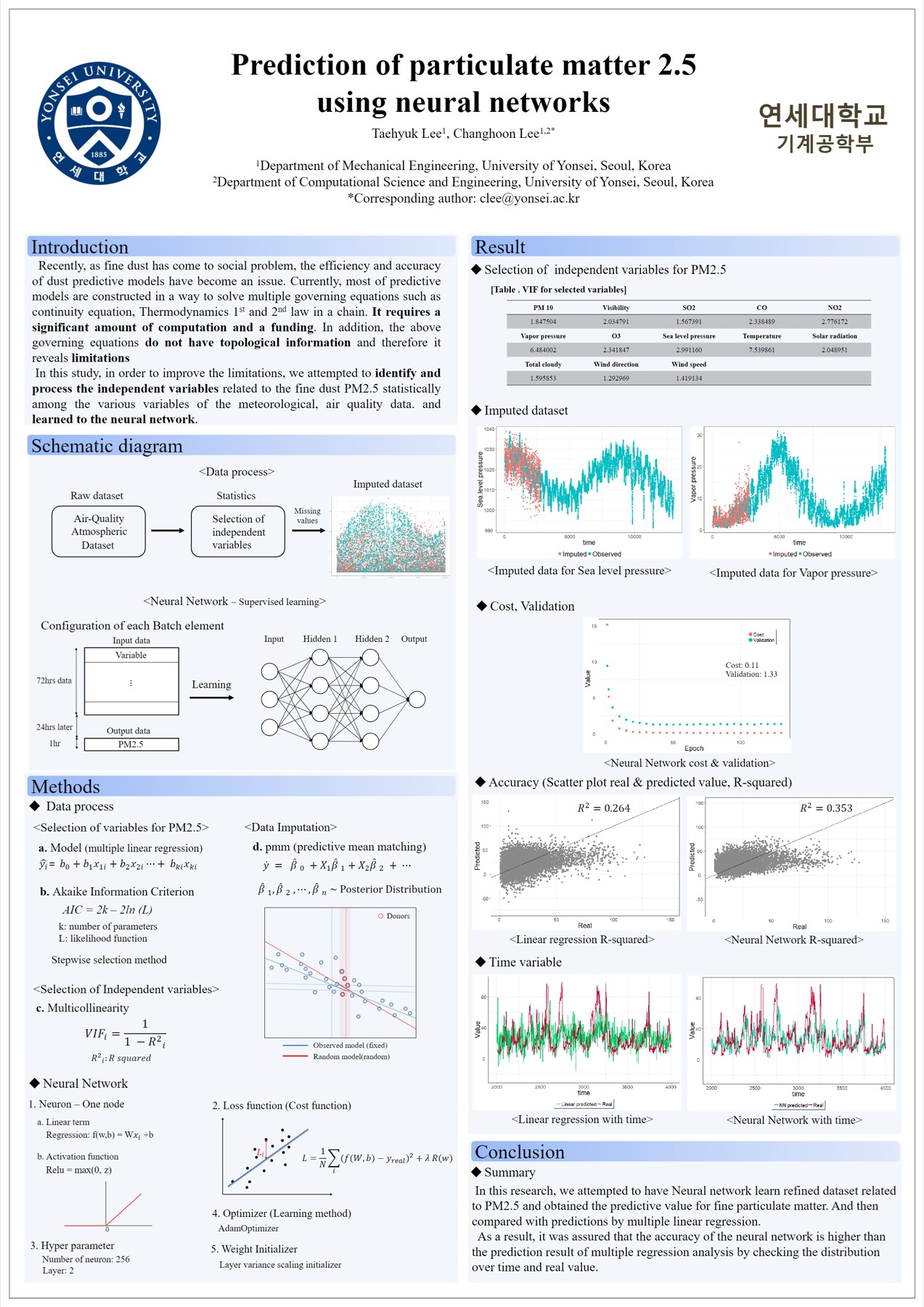
Undergraduate thesis developing a neural network to forecast fine particulate matter (PM2.5) — learning directly from statistically selected meteorological and air-quality variables instead of chaining together costly physical governing equations.
Key points
- Feed-forward neural network: 2 hidden layers, 256 neurons, ReLU activation, Adam optimizer, variance-scaling initializer.
- Forecast PM2.5 24 hours ahead from 72 hours of prior data (PM10, visibility, SO₂, CO, NO₂, O₃, temperature, pressure, solar radiation, wind…).
- Selected independent variables statistically via stepwise selection, AIC, and multicollinearity (VIF); imputed missing values with predictive-mean-matching.
- Benchmarked against multiple linear regression (real-vs-predicted scatter, R²).
- The network beat multiple regression (cost 0.11, validation 1.33), tracking real values more closely over time.
Figures